Unicorns as a media product
Some of the most rewarding papers are the ones that put numbers on something you already feel. Confirmation bias? Sure. It’s on SSRN, so surely this one must be real.
Anyway, something late-stage private market participants feel constantly is that the billion-dollar label is not just a valuation. It’s primarily a signal.
Shin, Kim, and Park study unicorns that first hit $1B between 2005 and 2019. PitchBook for deals, VentureXpert for co-investment networks, Factiva for press. Analysis sample: about 385 unicorns and 3,117 rounds.
What they find looks like a Schelling point at exactly $1B. Crossing that line coincides with a media spike and lower-centrality VCs showing up on the next rounds.
1. Valuations bunch at exactly $1B
Descriptive evidence first. Only 3% of VC-backed deals in their 2010–2019 window sat between $600M and $1B (98 of 3,117). Among unicorns, 21% (86 of 409) were valued precisely at $1B when they first crossed.
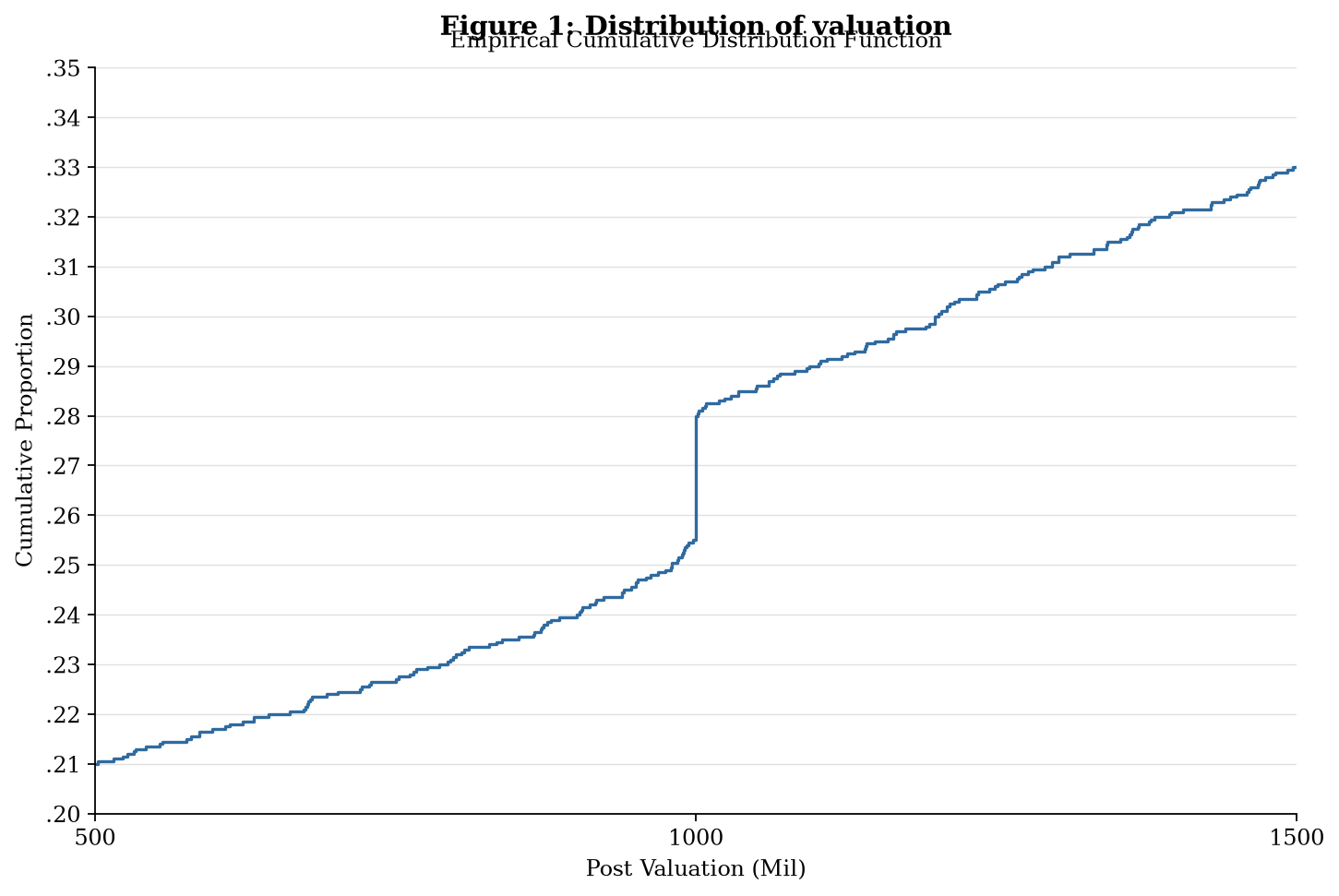
Figure 1. Empirical CDF of post-money valuations. Sharp jump at exactly $1B.
Revenue and EBITDA around the unicorn round do not jump with the label. The threshold looks negotiated.
2. Media jumps when the label sticks
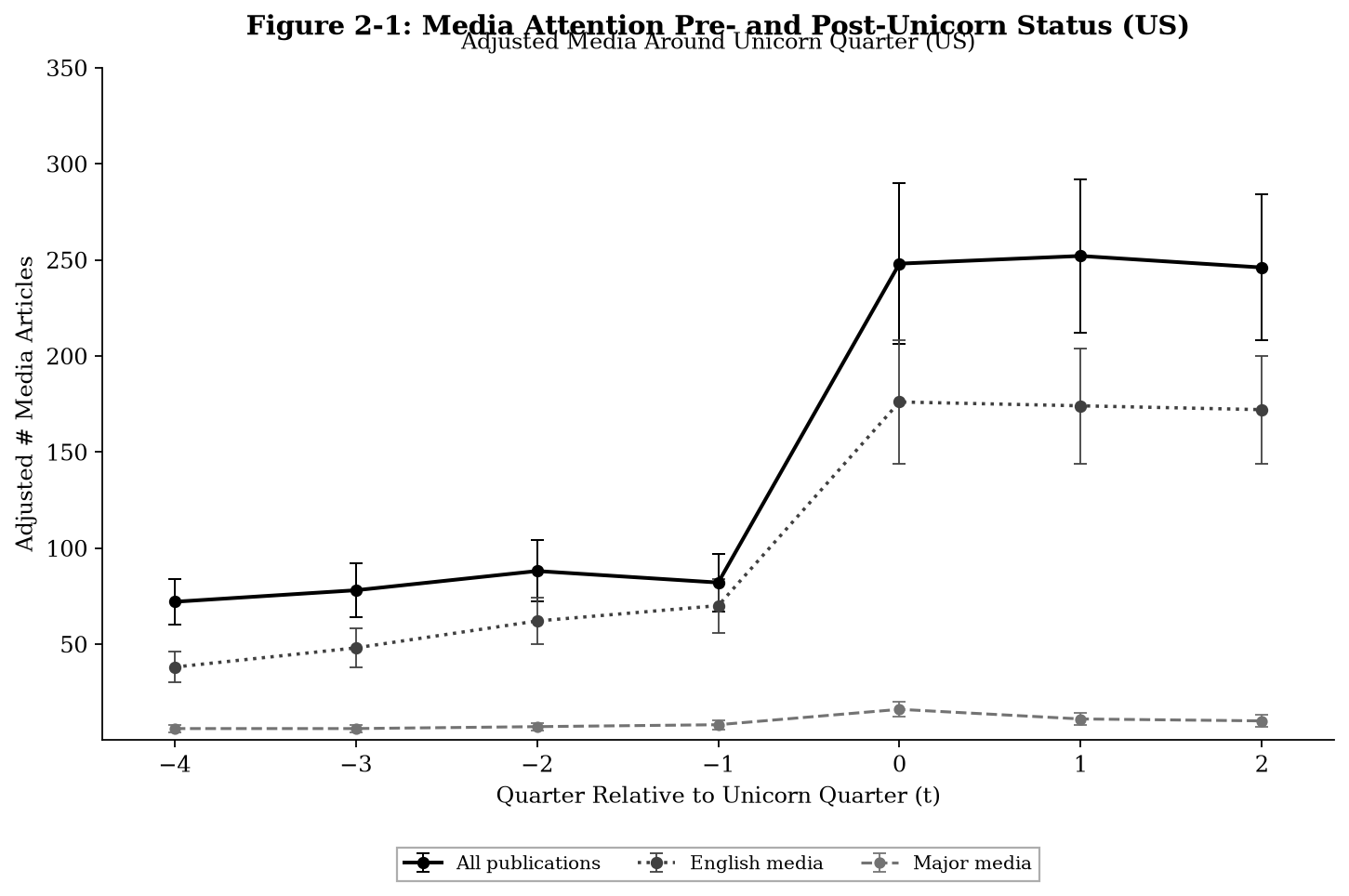
Figure 2-1 (US). Factiva article counts around the unicorn quarter. All / English outlets spike at t=0 and stay elevated. Major media barely moves.
In firm-quarter regressions the unicorn quarter is associated with a large rise in coverage (about +57 articles for all US Factiva, p < 0.001), and it stays elevated in the next two quarters. The action is in the long tail. Major media barely moves.
3. Great VCs mark the $1B
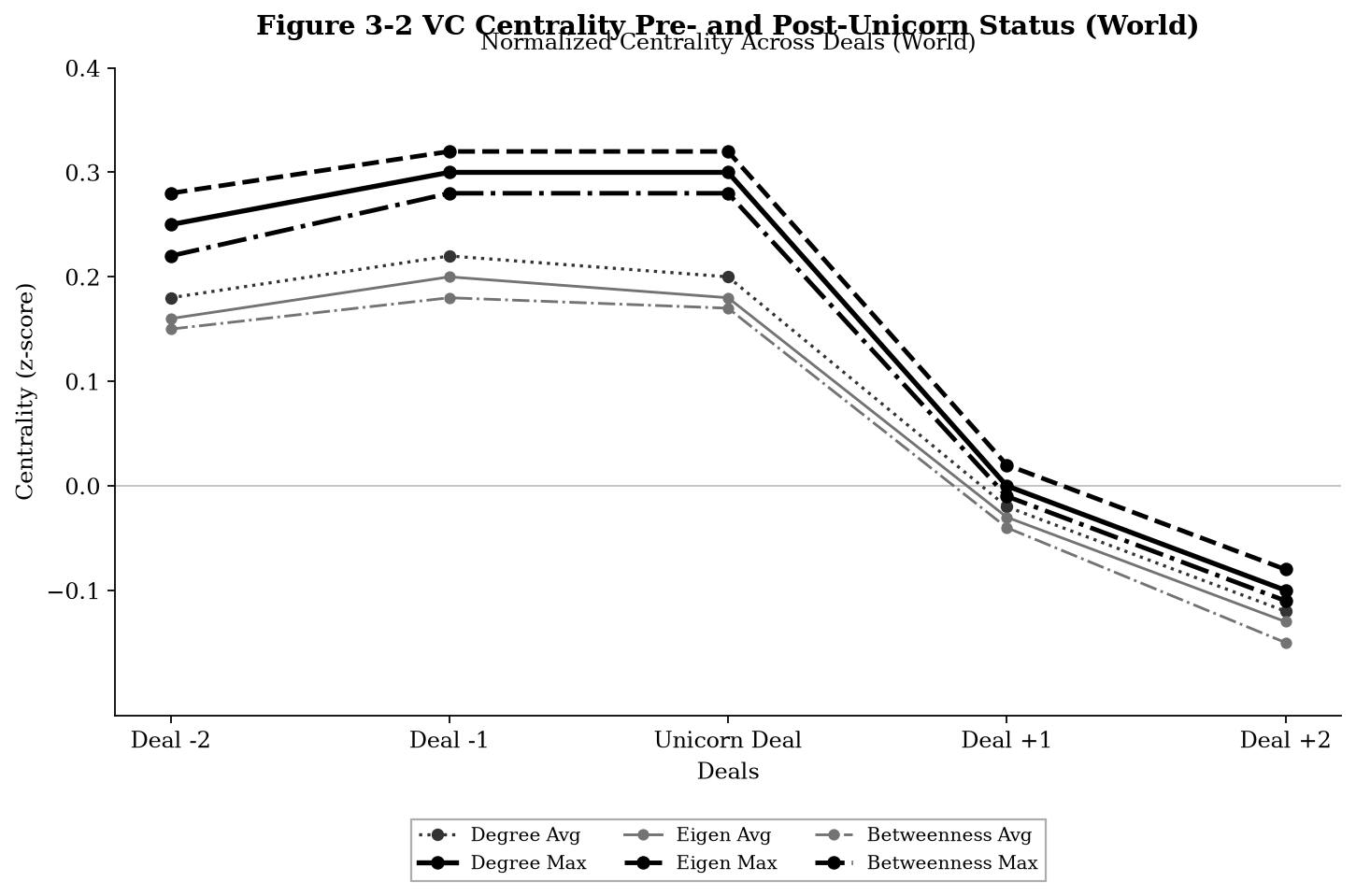
Figure 3-2 (World). Normalized network centrality of VCs across deals. Centrality is high through the unicorn deal, then drops on Deal +1 / +2.
Reputation here is network centrality (degree, betweenness, eigenvector) among active VCs. Newly joining investors after the unicorn round look worse on those graphs.
One way to read this: higher-centrality VCs take the unicorn round; lower-centrality VCs buy the fame on the next investment.
Why this is interesting
The conclusion matches what we already intuitively knew: unicorn status is in many cases a marketing event, and the money that shows up afterward is often of lower quality.
Source: S. Joseph Shin, Sunu Kim, and Haemin Dennis Park, Unicorns, Media Fame, and Dumb Money: The Strategic Inflation of Unicorn Startups’ Valuations (SSRN; posted 13 Dec 2025; written 1 Sep 2025).
Direct: papers.ssrn.com/abstract=5911322